Why Skilled Trades Education Is Moving Online
Discover why skilled trades students and apprentices are using online learning platforms to study technical concepts, prepare for trade exams and strengthen their job-site knowledge.
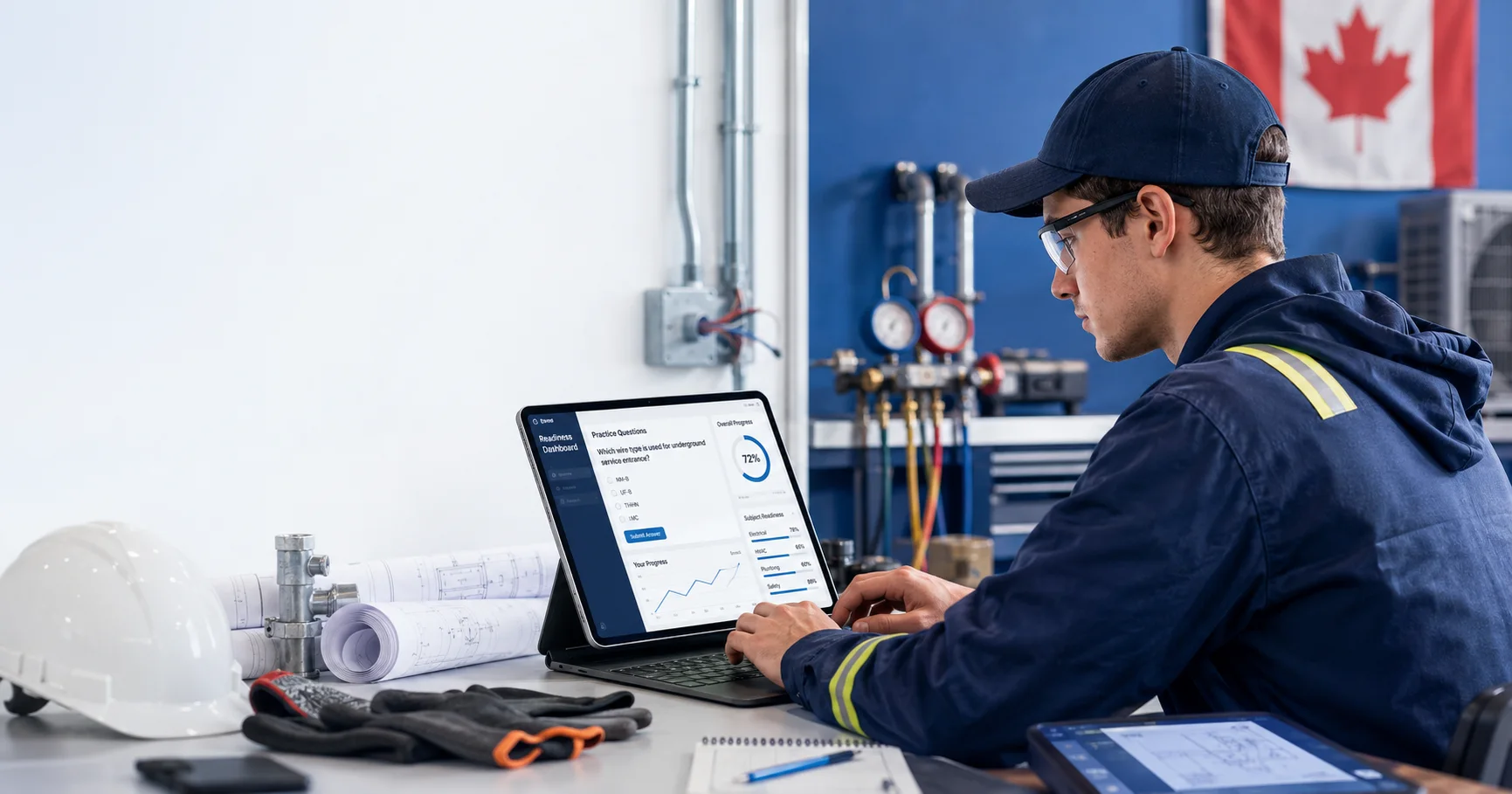
Skilled trades have always been built around hands-on experience. Electricians learn by wiring equipment. HVAC technicians learn by diagnosing systems. Mechanics learn by inspecting, repairing and testing vehicles.
That part of the trades is not changing.
What is changing is how trade students and apprentices prepare for the technical side of their careers. More learners are using online platforms to review code requirements, practise exam questions, understand difficult concepts and study around unpredictable work schedules.
The future of skilled trades education is not completely online. Instead, it combines practical job-site experience with flexible digital learning.
Skilled Trades Training Is Becoming More Flexible
Traditional apprenticeship training combines paid, on-the-job experience with periods of technical instruction. In Canada, apprentices generally learn under experienced tradespeople while completing the classroom training required for their occupation.
This system remains essential because no online course can replace the experience of using tools, diagnosing real equipment or working safely on an active job site.
However, trade students still need to learn a large amount of technical information, including:
Codes and regulations
Safety procedures
Equipment operation
Troubleshooting methods
Trade calculations
Drawings and schematics
Installation requirements
Exam terminology
Digital learning gives students another way to review this information outside the classroom and job site.
Rather than waiting for the next class or relying entirely on a textbook, students can study when they have time available.
Online Learning Fits the Reality of Apprenticeship
Many apprentices do not follow a typical student schedule.
They may work early mornings, evenings, weekends or changing shifts. They may travel between job sites, attend block-release training or balance school with family responsibilities.
A fixed study schedule can be difficult to maintain under those conditions.
Online skilled trades training allows students to study:
Before or after work
During breaks
While travelling
On weekends
From a phone, tablet or computer
In shorter, more manageable sessions
This flexibility can make it easier to remain consistent.
A student may not have two uninterrupted hours available every evening. They may still have 15 or 20 minutes to complete a practice set, review an explanation or revisit a weak topic.
Those shorter sessions can add up over time.
Trade Students Need More Than Textbooks
Textbooks, codebooks and curriculum materials remain important. However, reading information is not always the same as being able to apply it.
Trade exams often require students to:
Understand the question being asked.
Identify the relevant technical principle.
Interpret the available information.
Eliminate incorrect answers.
Apply the correct rule or calculation.
That requires active practice.
Online learning platforms can give students repeated opportunities to answer questions, review explanations and recognize the areas where they need more work.
Instead of simply rereading an entire chapter, a student can focus on a specific weakness such as motors, controls, refrigeration, electrical theory, safety or code navigation.
Immediate Feedback Makes Studying More Effective
One of the biggest advantages of digital learning is immediate feedback.
With traditional practice materials, students may answer several questions without knowing why an answer is right or wrong. That can allow misunderstandings to continue.
A well-designed online study platform can provide:
Immediate answer results
Explanations for incorrect answers
Progress tracking
Topic-specific performance
Recommended areas for review
Repeated practice with difficult concepts
This creates a more active learning process.
Students are not simply memorizing answers. They are identifying gaps in their understanding and correcting them before an exam or workplace assessment.
Online Platforms Can Personalize Trade Exam Preparation
Not every trade student struggles with the same material.
One apprentice may understand practical troubleshooting but struggle with calculations. Another may know the theory but have difficulty navigating code requirements. A third may need more practice interpreting diagrams and technical language.
A traditional study guide gives every student the same material in the same order.
Digital platforms can create a more personalized experience by tracking performance and showing students which subjects require the most attention.
For example, a readiness dashboard may show that a learner is performing strongly in workplace safety but needs more practice in electrical theory or equipment controls.
That information helps students use their study time more efficiently.
Practice Questions Help Students Prepare for Exam Conditions
Knowing the material is only one part of passing a trade certification exam.
Students must also manage:
Time limits
Multiple-choice questions
Technical wording
Similar-looking answer choices
Exam pressure
Long testing sessions
Online practice exams can help students become familiar with this format.
Timed simulations and mixed-topic question sets allow learners to practise making decisions under conditions that are closer to the real exam environment.
This does not guarantee that a student will pass. It can, however, make the testing format feel more familiar and reveal whether the student is ready to attempt the exam.
Digital Learning Is Expanding Across the Skilled Trades
The movement toward digital learning is not limited to private education platforms.
Governments and training organizations are also expanding online tools and digital services for apprentices. Canada provides online resources for apprenticeship training, career exploration, essential skills and financial support. Ontario also allows apprentices and sponsors to manage parts of the apprenticeship process online.
The federal government has also announced plans to further digitize parts of the Red Seal system through initiatives involving online examinations, digital logbooks and secure credentials.
These changes reflect a broader shift toward making skilled trades training and certification more accessible.
Digital learning is becoming part of the apprenticeship journey rather than a separate alternative to it.
Online Training Cannot Replace Hands-On Experience
Despite its benefits, online training has clear limitations.
A student cannot become competent in a trade by answering practice questions alone. Skilled trades require physical ability, judgment, communication, safety awareness and experience working with real systems.
Online learning cannot fully teach someone how to:
Safely operate tools and equipment
Work around live electrical systems
Diagnose equipment under real conditions
Coordinate with other workers
Respond to unexpected job-site hazards
Complete installations to professional standards
Government evaluations of apprenticeship programs have similarly recognized that remote learning can be less effective for material requiring hands-on practical instruction.
The strongest approach is blended learning.
Students develop practical skills through employment, apprenticeship and supervised training. They use online resources to reinforce the technical knowledge supporting that work.
Digital Tools Can Help More Students Enter the Trades
Canada needs accessible pathways into skilled trades careers.
Registered apprenticeship activity has continued to recover and grow following the disruption caused by the pandemic, reflecting continued interest in and demand for skilled trades training.
Online learning can make early trade education more approachable for:
High school students exploring career options
New apprentices preparing for technical training
Experienced workers challenging a certification exam
Students who need additional academic support
Workers living far from major training centres
Learners balancing employment and family responsibilities
Someone considering a trade can begin exploring its terminology, safety expectations and technical concepts before committing to a program.
That does not replace formal training, but it can help students make better-informed career decisions.
What Trade Students Should Look for in an Online Platform
Not every online course or question bank provides the same quality of learning.
Students should look for platforms that offer:
Trade-Specific Content
The material should reflect the actual occupation being studied rather than providing generic construction or mechanical information.
Clear Explanations
A correct answer is more useful when the student understands the principle behind it.
Progress Tracking
Students should be able to see their scores, improvement and weaker subject areas.
Mobile Access
A platform should work properly on the devices apprentices use throughout the day.
Realistic Practice
Questions should help students practise technical reasoning instead of encouraging them to memorize a small set of answers.
Updated Material
Trade regulations, codes and certification requirements may change. Students should confirm that study materials are current and appropriate for their jurisdiction.
Honest Expectations
No legitimate learning platform should guarantee that every user will pass a certification exam. Success still depends on the student’s knowledge, experience, preparation and performance.
How CodeSafe Supports Trade Students
CodeSafe Canada is developing digital study tools designed around the needs of trade students and apprentices.
The CodeSafe Academy helps learners practise trade-specific questions, review technical explanations and monitor their preparation over time.
Rather than replacing apprenticeship training, CodeSafe is designed to support it.
Students can use the platform to:
Practise questions from their selected trade
Identify weaker knowledge areas
Review explanations
Build consistent study habits
Prepare for Certificate of Qualification-style testing
Track their overall readiness
The goal is to make trade exam preparation easier to access, easier to understand and better suited to the schedules of working apprentices.
The Future of Skilled Trades Education Is Blended
The skilled trades will always require hands-on learning.
There is no digital replacement for working beside an experienced journeyperson, using real tools and solving problems in real environments.
However, the technical side of apprenticeship is becoming more flexible, measurable and accessible.
Online learning gives students the ability to study around work, practise difficult concepts and receive immediate feedback. When combined with classroom instruction and supervised job-site experience, these tools can help create more confident and better-prepared apprentices.
The trades are not moving away from practical training.
They are adding better digital tools to support it.
Start Preparing With CodeSafe Academy
Preparing for a skilled trade exam should not mean studying without direction.
CodeSafe Academy helps trade students practise relevant questions, identify areas for improvement and build confidence before their next exam.
Explore CodeSafe Academy and begin your trade exam preparation today.
Frequently Asked Questions
Can skilled trades training be completed entirely online?
Usually not. Skilled trades training requires supervised, hands-on experience in addition to technical education. Online platforms are best used to support classroom and workplace learning.
Is online learning useful for apprentices?
Yes. Online learning can help apprentices review theory, practise exam questions and study around changing work schedules.
Can online practice questions help with a Certificate of Qualification exam?
Practice questions can help students become familiar with technical wording, identify knowledge gaps and practise managing their time. They do not guarantee a passing result.
What is the best way to prepare for a trade exam?
A strong preparation plan normally combines practical experience, official curriculum material, code or regulatory resources, classroom instruction and realistic practice questions.
Does CodeSafe replace apprenticeship training?
No. CodeSafe is a supplemental study platform. It is designed to reinforce technical knowledge and support exam preparation, not replace recognized apprenticeship or hands-on training.